为什么贫穷
5.0 |2025年12月02日 |已完结
简介:

  贫富不均对社会有什么影响?穷人真能掌握自己的未来?国际非营利组织STEPS INTERNATIONAL 所推动的《为什么贫穷?》(Why Poverty?)跨媒体计划,参与协同制作工作,与全球同步播出一系列探讨21世纪贫穷问题的纪录片。
  《为什么贫穷?》是由总部位于丹麦的国际非营利组织STEPS INTERNATIONAL推动的非商业计划。Steps曾在2007年推动过《为什么要民主?》(Why Democracy?)。而《为什么贫穷?》即以此为基础,希望用影片刺激大众讨论贫穷问题;计划共同发起人还有英国广播公司(BBC)和丹麦广播公司(DR),这两家电视台也是本计划的主要合作伙伴和推动者。
  这计划邀请了来自世界各地的纪录片导演,以“为什么贫穷”为共同题目,拍摄了每集一小时共八集的纪录片,让世界共同思考贫穷问题,探讨全球10亿赤贫人口的过去与未来。本系列纪录片于2012年11月起全球播放,台湾PTS与英国BBC、美国PBS、日本NHK、香港RTHK等在内的70余家电视台均加入联合播出,估计观众总数超过 5 亿人。
  第1集 Poor Us: An Animated History of Poverty / 当我们穷在一起:动画贫穷史
  第2集 Welcome to the World / 人之初 性本穷
  第3集 Park Avenue: Money, Power and the American Dream / 有钱有庇护:金钱、权力和美国梦
  第4集 Land Rush / 耕者无其田
  第5集 Give Us the Money / 摇滚救贫穷
  第6集 Stealing Africa / 生财有“盗”
  第7集 Solar Mamas / 太阳能妈妈
  第8集 Education, Education / 出路

猜你喜欢
换一换
盲目的丈夫们
757
3.0
HD中字
盲目的丈夫们
3.0
更新时间:2025年12月05日
主演:萨姆·德·格拉斯,Francelia Billington,埃里克·冯·施特罗海姆,Fay Holderness,Richard Cumming
简介:

  Two differences between this Austrian version and the generally available American version are immediately obvious: they differ both in their length and in the language of the intertitles. The American version is only 1,883 metres long - at 18 frames per second a difference of some 7 minutes to the Austrian version with 2,045 metres. Whereas we originally presumed only a negligible difference, resulting from the varying length of the intertitles, a direct comparison has nevertheless shown that the Austrian version differs from the American version both in the montage and in the duration of individual scenes. Yet how could it happen that the later regional distribution of a canonical US silent film was longer than the "original version"?
  The prevalent American version of Blind Husbands does not correspond to the version shown at the premiere of 1919. This little-known fact was already published by Richard Koszarski in 1983. The film was re-released by Universal Pictures in 1924, in a version that was 1,365 feet (416 metres) shorter. At 18 frames per second, this amounts to a time difference of 20 minutes! "Titles were altered, snippets of action removed and at least one major scene taken out entirely, where von Steuben and Margaret visit a small local chapel." (Koszarski)
  From the present state of research we can assume that all the known American copies of the film derive from this shortened re-release version, a copy of which Universal donated to the Museum of Modern Art in 1941. According to Koszarski the original negative of the film was destroyed sometime between 1956 and 1961 and has therefore been irretrievably lost. This information casts an interesting light on the Austrian version, which can be dated to the period between the summer of 1921 and the winter of 1922. Furthermore, the copy is some 200 metres longer than the US version of 1924. If one follows the details given by Richard Koszarski and Arthur Lennig, this means that, as far as both its date and its length are concerned, the Austrian version lies almost exactly in the middle between the (lost) version shown at the premiere and the re-released one.A large part of the additional length of the film can be traced to cuts that were made to the 1924 version in almost every shot. Koszarski describes how the beginning and the end of scenes were trimmed, in order to "speed up" the film. However, more exciting was the discovery that the Austrian version contains shots that are missing in the American one - shots/countershots, intertitles - and furthermore shows differences in its montage (i.e. the placing of the individual shots within a sequence). All this indicates that Die Rache der Berge constitutes the oldest and most completely preserved material of the film.

2952
1919
盲目的丈夫们
主演:萨姆·德·格拉斯,Francelia Billington,埃里克·冯·施特罗海姆,Fay Holderness,Richard Cumming
山姆·克莱默克的时间机器
191
6.0
HD中字
山姆·克莱默克的时间机器
6.0
更新时间:2025年12月05日
主演:Sam Klemke
简介:

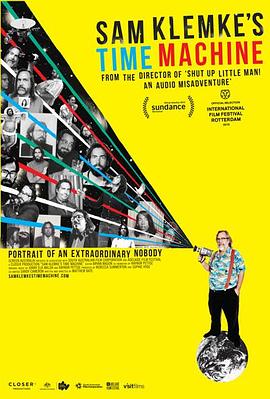
  Since 1977, Sam Klemke has been recording himself on film, the ♯selfieavantlalettre. In that same year, NASA launched the Voyager with the Golden Record. Whereas NASA primarily sketches a positive picture of humanity, Klemke&♯39;s honest self portraits zoom in on the individual. A special film about time, memory and what it means to be human.
  ‘This year will be my year, it has to be!’ Since 1977, Sam Klemke - a pioneer status updater - has looked back on ‘his year’ using video. With the illusion of progress, he hopes to encourage ‘personal growth and improvement’.
  Documentary maker Matthew Bate met Klemke on Facebook and became acquainted with his video 35 Years Back Through Time, a super-cut in which Klemke counts backwards from 2011 to his ambitious teenage self. Intrigued by this obsessive film project, Bate used Klemke&♯39;s personal archive to create a documentary collage that feels like an intimate road trip, with Klemke providing valuable lessons about time. Along the way, he dismantles the dream of success and happiness. Klemke&♯39;s self-mockery and honesty give the whole thing a light, breezy feel.
  Through this, Bate interweaves NASA’s Golden Record Project which, just like Klemke’s video project, was launched in 1977. This juxtaposition creates a reflection in which Bate sketches the comprehension of time and self-documenting stories as an inherent human need.

2154
2015
山姆·克莱默克的时间机器
主演:Sam Klemke
评论区